Millionaire 2026 Quiz & Trivia
- 4.4
- Rating
- 100.00M
- Installs
- Free
- Price
 Analysis by App-foxy
I approached Millionaire - Trivia IQ Games as a quick general-knowledge challenge rather than a game that asks for long sessions. Its central appeal is simple: answer questions, test what you know, and use the experience as a small mental workout. After spending time with it, I found that the strongest part is the low barrier to entry. You can pick it up when you have a few spare minutes, play without depending on a constant connection, and stop without feeling that you have abandoned a complicated campaign.
The game comes from Quiz & Trivia Games by Submarine Apps and sits in the trivia category. It is free to download, rated for Everyone, and supports devices running Android 6.0 or later. That combination makes it easy to recommend to families, casual quiz fans, and anyone who wants something lighter than a strategy game. My recommendation is not unconditional, though. People who need carefully explained answers, deep subject specialization, or a highly transparent competitive system may find the experience less satisfying than a dedicated learning app or a live quiz platform.
How the quiz feels in everyday use
I find the everyday appeal of this quiz less about squeezing in a certain number of questions and more about how easily it can fit around other plans. A useful way to judge that fit is to notice whether a short session feels like a refreshing pause or one more thing demanding your attention. That distinction leads naturally to the practical question of what happens when you play for longer.
In-Depth Coverage of Millionaire 2026 Quiz & Trivia
A practical game for short, offline moments
The offline focus changes where this title fits in my routine. I can imagine using it on a flight, during a commute with unreliable reception, or while waiting for an appointment. It does not need to become the main event of the day. A few questions can fill an awkward pause, while a longer session works when I am in the mood to keep testing myself. That flexibility is more useful than it sounds because trivia games often lose their appeal when every round depends on a live opponent or a stable connection.
One realistic use case is a quiet evening when I want to put my phone down soon but still do something active. I can open the game, work through questions, and leave once my attention starts to fade. It is also suitable for sharing a device with a family member: one person can read a question aloud, everyone can choose an answer, and the result becomes a conversation starter. I would not treat it as a formal family board-game replacement, but its straightforward format makes that kind of informal use possible.
The store summary presents it as a brain-training quiz built around daily general-knowledge questions. In my experience, that wording points to the right expectation: this is broad trivia, not a course with a planned curriculum. The subjects can appeal to a wide audience, but broad coverage also means the game may move quickly between areas you know well and areas where you are guessing. I enjoy that unpredictability, although someone looking for a controlled path through history, science, or language should choose a more specialized tool.
What the question format rewards
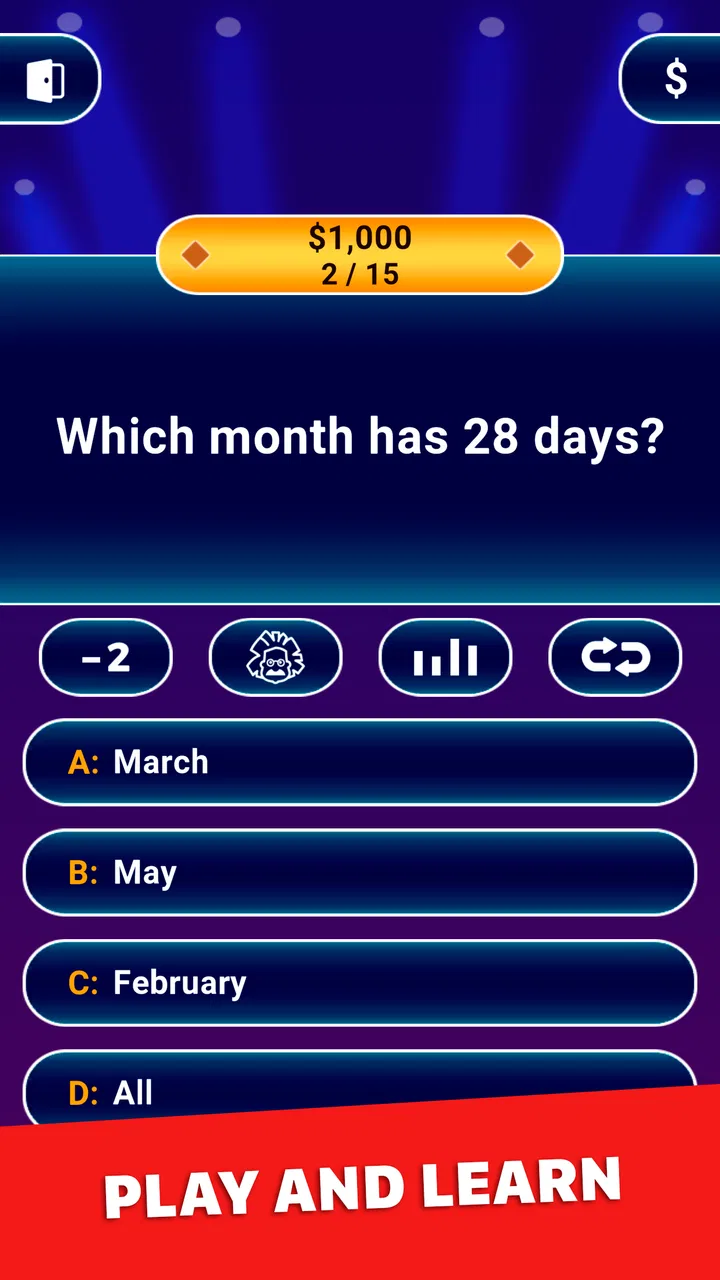
General-knowledge quizzes reward recognition, elimination, and calm decision-making as much as memorized facts. I found that I often knew the answer only after removing two obviously weaker choices. That makes the game approachable for people who are not walking encyclopedias, but it also creates a particular kind of pressure: a question can feel easy until two plausible options remain. The best way to play is to slow down briefly, identify exactly what the question asks, and avoid changing an answer simply because the wording makes you nervous.
A useful personal rule is to separate confidence from speed. If I know an answer, I answer promptly. If I am uncertain, I reread the question and check whether it asks about a person, place, date, cause, or definition. This small habit makes the game more enjoyable and turns mistakes into a way to notice gaps in my general knowledge. It is a more constructive approach than tapping quickly just to chase a streak or finish a round.
The game’s “Millionaire” identity also creates an expectation of rising tension and high-stakes choices. Even when I am playing casually, that framing makes familiar questions feel more consequential. It can be motivating, especially for players who like the feeling of climbing toward a goal. The trade-off is that players who prefer relaxed flashcards may find the presentation more dramatic than necessary. I would choose this over a plain question bank when I want entertainment, but not when I want a quiet, methodical study session.
Progress without turning trivia into homework
Progress works best here as a reason to return, not as a substitute for learning. I like having a recurring reason to test myself, because repeated exposure can reveal which topics consistently cause trouble. After a session, I would mentally note the questions I missed and, if one subject keeps appearing as a weakness, look it up separately. The game can point me toward topics worth exploring, but I would not rely on it alone to teach the background behind every answer.
This distinction matters for younger players. The Everyone rating makes the game broadly accessible, and the question format can encourage curiosity, but an incorrect answer may not provide enough context for a child to understand why it was wrong. I would be comfortable letting a child play independently for entertainment, while recommending that an adult join in when the goal is actual learning. Asking “why is that the answer?” after a missed question turns a quick round into a much better educational moment.
For adults, the most effective routine is to use it as a warm-up rather than a test of intelligence. Playing before reading, studying, or tackling a demanding task can be a pleasant mental reset. I would avoid using a score as a judgment of my ability, since general knowledge depends heavily on the subjects I happen to encounter in daily life. A missed question is useful information only if I treat it as a prompt to investigate, not as evidence that I am bad at trivia.
Where pressure helps and where it gets in the way
The millionaire-style setup gives ordinary questions a sense of occasion. That is the main emotional hook, and it works for me when I want a little tension without committing to a competitive match. However, pressure can also make the experience less fair to a player who knows the material but dislikes timed or theatrical decision-making. If you tend to second-guess yourself, the game may feel more stressful than a standard flashcard app, even though the underlying task is similar.
You May Also Like

 Lords Mobile: Kingdom Wars
Lords Mobile Is a Kingdom-Building Routine, Not a Quick Match
A case-by-case verdict on the building, battles, device demands, and social commitments that make Lords Mobile rewarding for some players and exhausting for others.

 PDF Scanner app - TapScanner
TapScanner Makes Paperwork Easier to Capture, Check, and Share
TapScanner makes scanning with a phone feel less like a rescue operation and more like a dependable step in getting work done. Its capture tools are useful, though not flawless.

 Block Blast!
 Shows How Much a Puzzle Game Can Leave Out
A quiet grid game shows why puzzle players increasingly value instant clarity, repeatable skill and low-pressure play—and where the genre still needs to catch up.

 Family Space
 Review: A Shared Routine That Makes Family Life Easier
A parenting app earns its place not by adding more noise, but by making everyday coordination easier. Family Space gets that balance mostly right.

 1Weather Forecasts & Radar
 Makes the Daily Check Worthwhile
A good forecast does more than predict rain. This week's pick turns changing conditions into a clear, practical reason to check before you step outside.

 Clash of Clans
 Makes Patience Part of the Strategy
A village builder with a sharp tactical core, Clash of Clans turns patience into momentum and each raid into a small, satisfying act of judgment.
More From Our News Desk
View All News


I recommend playing in two different modes of thought. In the first, answer naturally and accept mistakes; this is best for relaxation. In the second, treat each question as a reasoning exercise and explain your choice to yourself before tapping. Switching between these approaches prevents the game from becoming a repetitive reflex test. It also helps reveal whether I am improving my knowledge or merely becoming familiar with recurring patterns.
Fairness when the player is spending nothing
Because the game is free, the most important spending question is how comfortable you are using a no-cost title whose complete purchase details are not part of the information available to me. I would not promise that every optional purchase, advertisement arrangement, or interruption works in a particular way. Instead, I would advise readers to inspect the current store screen and the in-game purchase prompts on their own device before committing money. That is the honest boundary between what I can recommend and what I should not assume.
My practical advice is simple: start as a free player and decide whether the basic quiz loop is enjoyable before considering any payment. Do not spend to recover a lost run, protect a streak, or chase a particular result unless you already understand exactly what the purchase provides. Trivia is easy to keep playing when a question feels almost within reach, so a small moment of frustration can encourage an unnecessary purchase. I prefer to close the game and return later rather than pay because I am annoyed by a mistake.
There is also a fairness issue that has nothing to do with money. A broad trivia game naturally favors people whose interests match its question mix. Someone who reads about geography may have an advantage over someone who spends more time with arts or sports, even if both are equally intelligent. I would judge the game by whether it gives me an enjoyable challenge, not by treating its results as a universal ranking. That mindset keeps the experience fairer for families and casual groups with very different backgrounds.
How it compares with ordinary alternatives
Compared with a traditional trivia app built around subject categories, this game is more appealing when I want a single, recognizable quiz-show atmosphere. A category-based alternative is better when I want to practice one field deliberately or avoid topics I already know too well. Compared with live multiplayer trivia, this title is more convenient and less socially demanding because I can play offline and at my own pace. The live option is stronger when the excitement comes from competing with real people and reacting to their performance.
It also differs from flashcard software. Flashcards are usually better for deliberate repetition, vocabulary building, and retaining a defined set of information. Millionaire-style trivia is better at creating surprise and testing whether knowledge is available under pressure. I would use both differently: flashcards for a planned learning goal, this game for variety and mental stimulation. Choosing between them depends less on which is “best” and more on whether I want structured study or entertaining recall.
Against a paper quiz book, the app wins on convenience and portability. A book may be preferable for someone who wants to avoid screen time, keep notes beside questions, or control the pace without notifications and other phone distractions. The app’s advantage is that it is always close at hand and can turn a short wait into a playable session. Neither format automatically gives better explanations, so I would still verify interesting or disputed facts through a reliable reference when accuracy matters.
Competitive fairness and the limits of comparison
I would be cautious about presenting this as a serious competitive platform. Its broad appeal comes from being accessible and self-contained, not from proving who is the smartest person in a room. Without treating every result as a formal ranking, I can enjoy the challenge without worrying whether a difficult question reflects genuine skill, a lucky guess, or familiarity with a particular subject.
That is especially important if several people are taking turns. To keep the comparison fair, I would give everyone the same amount of time to read each question, avoid shouting answers while another person is still thinking, and treat controversial wording as a discussion rather than an argument. If a group wants a tightly regulated contest with synchronized rounds and transparent scoring, a dedicated multiplayer quiz service may be a better choice. This app works more naturally as a shared casual challenge.
For solo players, competition can be internal: can I make a more careful decision than last time, or can I identify a weak subject? I find that kind of progress more meaningful than comparing scores across people with different knowledge. A useful trick is to keep a small note of recurring mistakes outside the app. That creates a personal learning loop without pretending that the game itself is a complete study system.
What I would check before making it a regular habit
The game has a substantial audience, with an average rating of 4.5 from around 373 thousand ratings and more than 100 million installs. Those figures suggest that the format has broad appeal, but they do not tell me whether it will suit my preferred question difficulty, tolerance for interruptions, or expectations about explanations. I still pay attention to the first few sessions rather than assuming popularity guarantees a perfect fit.
The current version is 1.8.2.5, and the game was released on May 23, 2019. For me, the useful takeaway is that this is an established title rather than something I would approach as a brand-new experiment. I would still check the current app page before installing, especially on an older device, and make sure the operating-system requirement fits my phone. The minimum requirement of Android 6.0 keeps it accessible to many older Android devices, though actual smoothness can vary with hardware and system condition.
I would also observe how the game handles a few practical questions during setup and play: whether the offline behavior matches my needs, how often interruptions appear, and whether the wording feels clear enough to trust. Those are personal-use checks, not details I would invent on behalf of the developer. If the first session feels cluttered or the questions do not suit my interests, no amount of popularity should persuade me to keep it installed.
Who should play and who should skip it
I think it is a strong fit for casual quiz fans, families wanting a simple turn-taking activity, commuters who need an offline distraction, and adults who enjoy testing broad knowledge without studying a syllabus. It is also a good choice for someone who likes the emotional rhythm of a quiz show but does not want to wait for opponents or coordinate a group. The free entry makes it easy to try without making the decision feel significant.
I would steer serious learners toward a more structured app if their goal is exam preparation, language retention, or mastery of a narrow subject. I would also suggest a live multiplayer alternative to anyone whose main motivation is social competition. Players who dislike uncertainty, dramatic presentation, or questions outside their favorite topics may prefer a calmer category-based quiz. Finally, anyone who wants every answer explained in depth should treat this as a prompt for further research, not as a standalone reference work.
My trust verdict after weighing the trade-offs
My final view is positive but measured. Millionaire - Trivia IQ Games succeeds because it makes general knowledge immediately playable, works as an offline pastime, and does not demand a large time commitment. The Everyone rating and broad subject approach make it approachable, while the quiz-show framing gives simple questions enough tension to keep me engaged. I especially value it as a small daily habit that can expose gaps in my knowledge without turning those gaps into a source of embarrassment.
The limitations are just as important. It is not the right tool for systematic education, a guaranteed explanation of every answer, or rigorous competitive ranking. Spending should be approached carefully: begin with the free experience, read any purchase prompt closely, and never pay merely because a difficult question has created pressure. Since purchase details can change and are not something I should assume, checking the current store and app screens is part of making an informed decision.
If I were recommending it to a friend, I would say: install it if you want a familiar millionaire-style trivia challenge that you can use in short offline sessions. Play slowly enough to learn from mistakes, use missed questions as ideas for further reading, and judge it by enjoyment rather than by a single score. For a free general-knowledge game from Quiz & Trivia Games by Submarine Apps, it earns a place on my casual-play list, provided you understand that its strength is entertaining recall—not complete instruction or perfectly controlled competition.
FAQs for Millionaire 2026 Quiz & Trivia
01What is Millionaire - Trivia IQ Games all about?
Millionaire - Trivia IQ Games is a quiz app that challenges your knowledge across various categories, aiming to recreate the excitement of a classic TV game show. Players answer multiple-choice questions to advance levels and earn virtual currency, mimicking the format of becoming a 'millionaire' by testing their IQ and general knowledge.
02Is Millionaire - Trivia IQ Games free to play?
Yes, Millionaire - Trivia IQ Games is free to download and play. However, the app includes optional in-app purchases and advertisements. Players can buy virtual currency for additional hints or to continue playing after incorrect answers, which enhances the gaming experience but is not mandatory for progression.
03What features does Millionaire - Trivia IQ Games offer?
The app features a wide range of trivia questions across various topics such as history, science, pop culture, and more. It includes lifelines like '50/50' and 'Ask an Expert' to assist players. Additionally, there are leaderboards to compete with friends and daily challenges to keep the gameplay fresh and engaging.
04Can I play Millionaire - Trivia IQ Games offline?
Millionaire - Trivia IQ Games requires an internet connection to access the latest questions and features, including leaderboards and daily challenges. While some gameplay elements might be accessible offline, the full experience, including updates and competitive features, is best enjoyed online.
05How often is new content added to Millionaire - Trivia IQ Games?
The developers regularly update Millionaire - Trivia IQ Games with new questions and features to keep the experience engaging. Frequent updates ensure a diverse range of topics and maintain the challenge for seasoned players. Checking for app updates regularly is recommended to enjoy the latest content.
Pros
- Engaging trivia questions enhance knowledge.
- Smooth user interface and easy navigation.
- Regular updates with new content.
- Multi-language support expands accessibility.
- Offline mode available for on-the-go play.
Cons
- Ads can be intrusive during gameplay.
- Limited free hints may frustrate players.
- Repetitive questions over time.
- Requires internet for some features.
- In-app purchases can be pricey.

Millionaire 2026 Quiz & Trivia
Gallery